
Some heroes wear medals. Nicholas Winton wore none. For fifty years, he carried the greatest rescue of his life in silence — until one night on live television, the truth stood up in front of him.
A Holiday That Changed Everything
In 1938, Nicholas Winton was a 29-year-old stockbroker in London, the son of German-Jewish parents who had immigrated to Britain years earlier. He had planned a skiing holiday in Switzerland. Instead, he changed his plans and travelled to Prague.
What he saw there stayed with him forever. Czechoslovakia was in danger, and refugee families were living in terrible conditions as the threat of Nazi invasion grew. Among them were thousands of children — frightened, hungry, and completely unprotected. Winton looked at those children and made a decision that would define the rest of his life: he would get as many of them out as he could.
AI recreation — Winton compiling his lists in Prague, 1939
The List That Saved Lives
Winton had no organization behind him, no government funding, and no official title. He turned his Prague hotel room into a temporary office and began compiling lists — name after name of children in danger.
Then he returned to Britain and got to work. After long days at his job, he spent his evenings writing letters, raising money, and fulfilling the legal requirements to bring the children to Britain. Every child needed a home and a sponsor waiting for them. Winton found hundreds of British families willing to open their doors, one letter at a time.
Eight Trains to Freedom
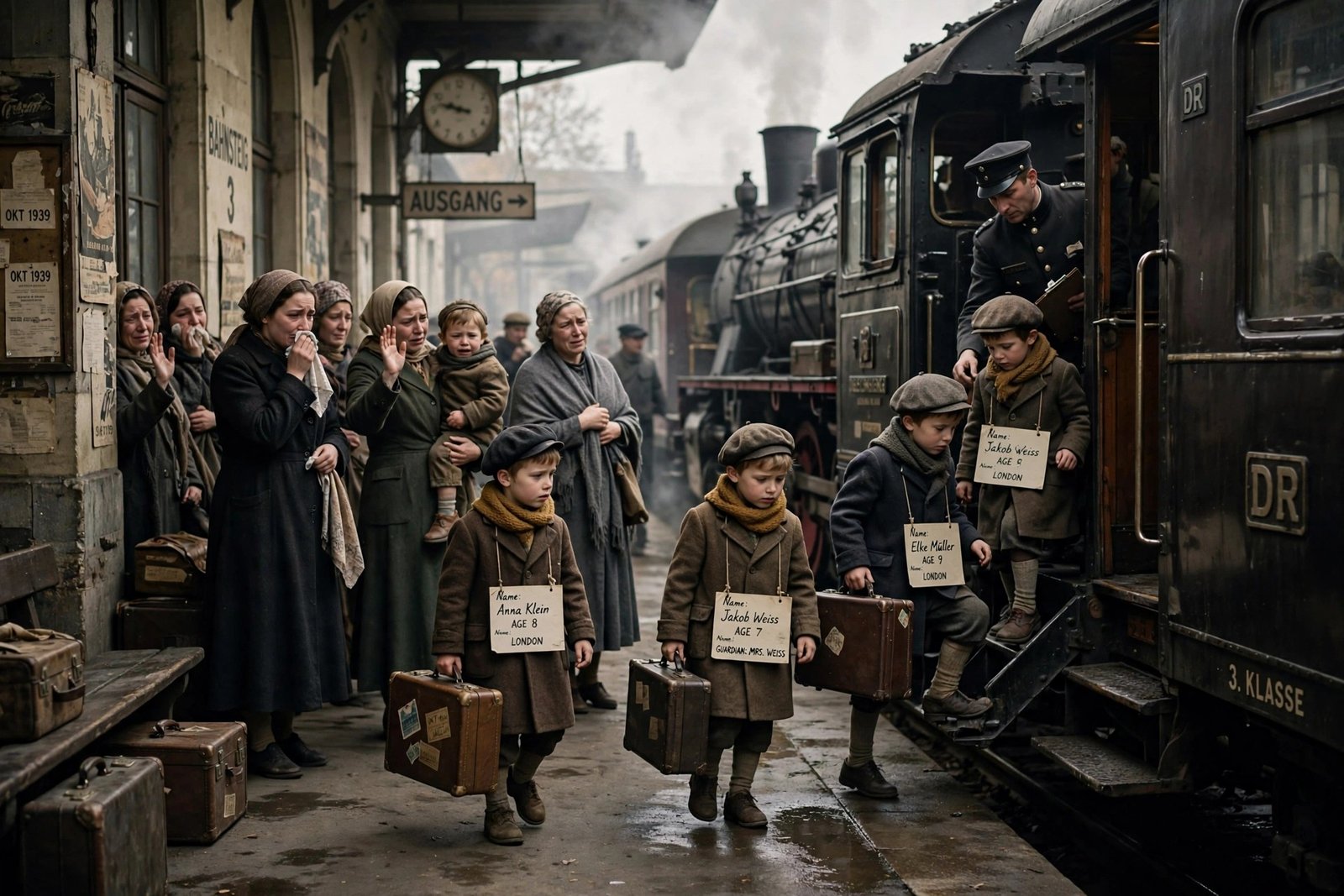
Between March and August 1939, Winton organized eight transports of children from Prague to London. The first left on March 14, 1939 — the very day before German troops occupied the Czech lands. The last trainload departed on August 2, 1939.
In total, 669 children — most of them Jewish — were carried to safety in Great Britain. At the train station in London, British foster parents waited to collect children they had never met, children whose names they had only seen on Winton’s lists.
AI recreation — children boarding one of the rescue trains, 1939
The Ninth Train That Never Left
There was supposed to be a ninth train. It was to be the largest of all, carrying 250 children, and it was scheduled to leave Prague on September 1, 1939.
That was the day Germany invaded Poland. Britain declared war. The borders closed, and the ninth train never left the station. Within hours, it had disappeared. None of the 250 children on board were ever seen again.
Two hundred and fifty families waited at Liverpool Street station in London that day in vain. If the train had left just one day earlier, those children might have lived. It remains the most heartbreaking page of Winton’s story — and the reason he never considered himself a hero.
The Secret He Kept for Fifty Years
After the war, Winton simply went home and lived his life. He never spoke about the trains, never sought recognition, never told even his own friends what he had done. When people later called him a hero, he brushed it off. He had not been in danger himself, he said — so how could he be a hero?
For nearly fifty years, the world knew nothing. Then, in 1988, his wife Grete was tidying their loft and came across an old scrapbook. Inside were the lists — the children’s names, their parents’ names and addresses, and the details of every family that had offered a home. The entire rescue, documented in one man’s careful handwriting, had been sitting in an attic for half a century.
AI recreation — the scrapbook that kept the secret for fifty years
The Night the Whole Audience Stood Up
In February 1988, Winton was invited to sit in the audience of the BBC television programme “That’s Life!”, hosted by Esther Rantzen. He had no idea what was coming.
On live television, his scrapbook was shown and his story was told. Then the host asked a simple question: would everyone in the audience whose life had been saved by Nicholas Winton please stand up?
Row after row of adults rose to their feet. These were the children from the trains — now grown, with children and grandchildren of their own. Winton turned, looked around, and broke down in tears. He had saved them as small frightened children at a Prague station. Now they were standing around him, applauding, alive because of what he did.
AI recreation — the emotional 1988 television reunion
What a Real Hero Looks Like
Nicholas Winton never got over the ninth train. Of the 669 children he saved, more than 370 were never traced — their stories scattered by war. But the ones who were found built lives, families, and generations. Today, thousands of people around the world owe their existence to a young stockbroker who cancelled a skiing holiday.
He saved 669 children and told no one for fifty years. That is what a real hero looks like — not someone who seeks the light, but someone who quietly carries others toward it.