

The Familiar Route

Dennis had driven the same road home for eleven years. He knew every curve, every gas station, every spot where the sun hit the windshield just right at golden hour. It was the kind of drive you could do half asleep — and on that particular evening, coming back from a long day, he was close to it.
The sun was melting into the horizon, painting the highway orange. Dennis had the window cracked, the radio low. All he wanted was dinner and his couch.
Then something caught his eye.
A Thumb on the Side of the Road
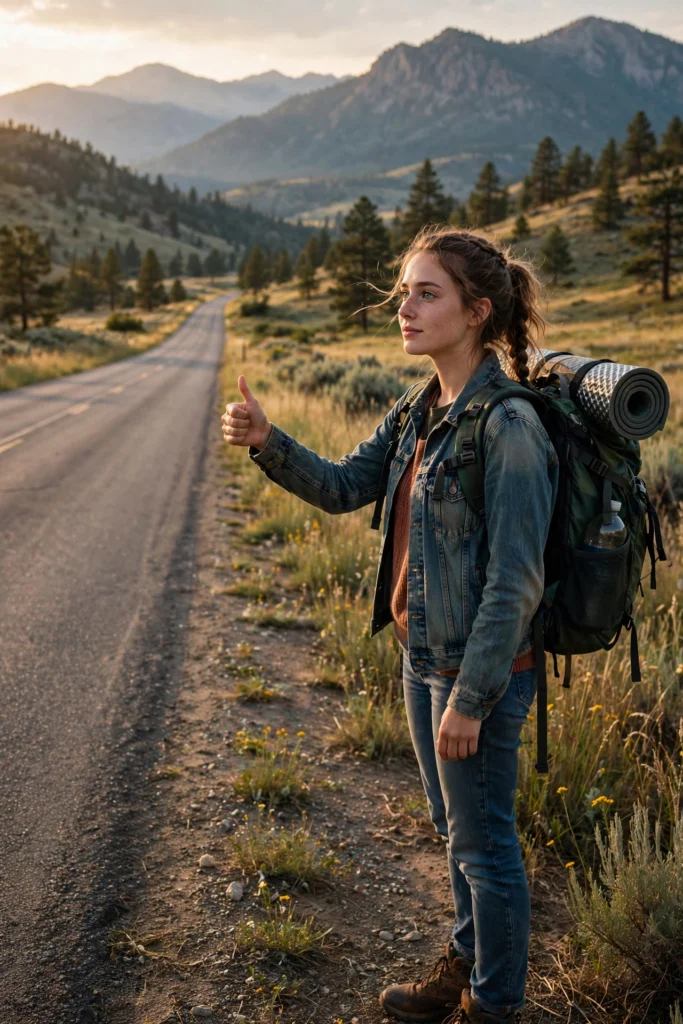
She was standing on the shoulder, half in the tall grass, with her thumb out. A young woman — early twenties, maybe — with a backpack slung over one shoulder and a tired look that suggested she’d been standing there a while.
Dennis’s foot lifted off the gas before his brain caught up.
He didn’t pick up hitchhikers. He’d made that rule years ago, after hearing one too many stories. It was always the same advice: keep driving, mind your own business, don’t get involved. And for eleven years, he’d followed it without exception.
But something about the scene made him hesitate. The road was empty in both directions. The sun was going down fast. And the girl — she didn’t look dangerous. She looked stranded.
Dennis glanced in his rearview mirror. Then at the girl. Then at the mirror again.
He pulled over.
Against His Better Judgment
He stopped a few yards ahead of her and leaned across to roll down the passenger window. She approached slowly, cautiously — the way anyone with sense would approach a stranger’s car.
“Do you need a ride?” Dennis asked. He kept his voice steady but kind, the way you’d talk to a nervous animal.
She studied him for a long moment. Then, quietly: “I need to get home.”
“Where’s home?”
“There’s a train station about forty minutes that way,” she said, pointing down the road. “I can get home from there.”
Dennis nodded. “Hop in.”
She slid into the backseat — not the front, he noticed — and pulled her backpack onto her lap like a shield.
The Quiet Passenger

“I’m Dennis, by the way,” he said as he merged back onto the highway.
“Harper,” she said softly. And that was nearly the entire conversation.
Dennis tried, the way decent people do. He asked where she was coming from. He commented on the weather. He asked if she was visiting family. Harper answered in the shortest possible sentences, her eyes fixed on her phone, her thumbs moving across the screen.
She wasn’t rude, exactly. She was somewhere else — the way people are when their mind is running a race their body can’t keep up with. Dennis recognized the look. He’d worn it himself, years ago, during the worst month of his life.
So he stopped trying to make conversation and just drove. The miles rolled by. The sun finished setting. Harper stayed curled against the window, the blue glow of her phone lighting her face.
Dennis told himself she was probably just tired. Probably just a young woman who’d missed her bus and needed a break. Nothing more to it than that.
He was wrong. But he wouldn’t know how wrong for another twenty-four hours.
No Thank You, No Goodbye
When they finally reached the train station, Harper was out of the car before Dennis had fully stopped. She grabbed her backpack, closed the door, and walked quickly toward the entrance without a backward glance.
No thank you. No goodbye. No wave.
Dennis sat there for a moment, engine idling, watching her disappear into the station. Something about it nagged at him — not fear, exactly, but a small cold feeling at the base of his spine. The whole ride, she’d said she needed to get home. But she’d asked to be dropped at a train station forty minutes in the wrong direction from any neighborhood.
He shook it off. People were strange. It wasn’t his business.
He drove home, ate dinner, and fell asleep on the couch with the TV on.
The News That Night

He woke up to the sound of the news anchor’s voice, sharp and urgent.
“…reported missing two days ago. Police are asking anyone with information to come forward.”
Dennis blinked the sleep from his eyes. On the screen was a photograph — a young woman with a backpack slung over one shoulder, smiling a small, tired smile.
His blood went cold.
It was Harper. There was no doubt about it. Same face. Same backpack. Same tired eyes he’d seen in his rearview mirror.
The anchor kept talking, but Dennis couldn’t hear the words over the pounding in his ears. A missing person. Two days. And yesterday evening, she had been sitting in his backseat, head down, typing on her phone, forty minutes from anywhere.
His hands started to shake. He turned pale — the kind of pale that comes when your brain is doing math you don’t want it to do. Where had she been going? Why hadn’t she wanted to go home? What had she been running from — or to?
And the worst thought of all: he’d dropped her at a train station and driven away. What if she was still out there? What if something happened after he left?
Dennis stood up, walked to the kitchen, and splashed cold water on his face. Then he picked up his phone and did the only thing he could think of.
The Call That Changed Everything
The detective on the missing persons tip line listened without interrupting while Dennis told the whole story — the highway, the thumb out, the quiet ride, the train station, the way she’d vanished without a word.
“You’re sure it was her?” the detective asked.
“I’d bet my life on it,” Dennis said.
“Mr. Dennis,” the detective said slowly, “you may have just cracked this case open.”
What Dennis learned in the days that followed filled in the blanks his imagination had been torturing him with. Harper, nineteen, had run away from home after a terrible fight with her family — not in danger from anyone else, but in danger from her own despair. She’d been drifting for two days, too proud and too scared to call home, telling herself she’d figure it out alone.
She hadn’t been heading home when Dennis picked her up. She’d been heading nowhere.
But Dennis’s tip — the train station, the exact time, the description — gave police a place to look. Station cameras confirmed it. And twelve hours later, officers found Harper sitting on a bench on platform three, her phone dead, her backpack empty of food, crying with relief when they said her name.
She was safe. She was going home — for real this time.
A week later, Dennis got a letter in the mail. No return address, just a single sheet of notebook paper in careful handwriting.
“Dear Dennis,” it read. “You stopped when nobody else did. You didn’t ask questions I couldn’t answer. You just drove. I didn’t say thank you at the station because I didn’t know how. So thank you now. You probably saved my life. — Harper.”
Dennis folded the letter and put it in his wallet, where it stayed.
He still drives the same road home. He still doesn’t pick up hitchhikers — well, almost never. But every time he passes that stretch of shoulder where he first saw her, he slows down just a little. Just in case.
Because sometimes the person with their thumb out isn’t just looking for a ride. Sometimes they’re looking for proof that the world still has kind people in it.
And sometimes, all it takes to save someone is stopping the car.